What would a 7% UUT raise?
This page presents the supplied household, commercial, exemption and housing assumptions in tables so readers can reconstruct the arithmetic.
Start with the basic numbers
The City describes these as different stages of the same funding problem. See the Escalation page for the full explanation and sources.
Standard modeled UUT rate.
Example reduced rate for eligible senior/CARE households in the supplied model.
Approximate current residual funding requirement; the City projects ≈$58M at construction.
What is a UUT?
Marina's proposed 7% UUT was placed on the November 2026 ballot by City Council action in July 2026. The City's July announcement describes the measure as a local funding source for public safety, emergency response and replacement of aging public facilities, with an estimated $69 million cost for the three priority facilities and approximately $19.3 million already saved or identified, leaving an estimated $50 million gap. The City also states that the estimated construction-time need is approximately $58 million because construction is not expected to begin for about three years.
The City-side conservative comparison uses a fixed $300 per household per month input. Separately, the City/Keyser Marston June 2026 analysis provides a broader, source-based average of approximately $496 per household per month. These are different modeling bases and are deliberately shown separately. It reports 8,254 occupied households as of January 1, 2025 and an all-household average monthly utility cost of $496.
Important distinction: the $496 is a documented average utility burden used in the City's modeling; it is not a universal Marina bill. Utility usage varies by household, service type and who qualifies. The proposed UUT scope and exemptions must be read from the final law and ballot materials.
City of Marina - July 9, 2026 ballot announcement · City/Keyser Marston UUT estimate - June 16, 2026
Utility costs used by the City consultant
| Utility category | Average $ / household / month | Documented source | Model note |
|---|---|---|---|
| Electric | $143 | City/Keyser Marston | 2026 UUT estimate |
| Gas | $69 | City/Keyser Marston | 2026 UUT estimate |
| Water | $82 | City/Keyser Marston | Included in total utility burden; verify final taxable scope |
| Phone / mobile | $110 | City/Keyser Marston | 2026 UUT estimate |
| Video / streaming / cable / satellite | $91 | City/Keyser Marston | 2026 UUT estimate |
| Total average utility cost | $496 | City/Keyser Marston | Average household / month |
The City's table also models a 7% UUT at $34.70/month for the average household under the 66% non-CARE/non-senior and 34% PG&E CARE/senior approach, and $29.30/month under its 3.5% reduced-rate approach. Those figures should not be silently replaced by an assumed $500 bill.
Where the utility-cost numbers come from
The City’s June 16, 2026 Keyser Marston analysis reports 8,254 occupied households as of Jan. 1, 2025 and an all-household average monthly utility cost of approximately $496: $143 electric, $69 gas, $82 water, $110 phone/mobile and $91 video. The City’s July ballot description says the proposed UUT applies to gas, electricity and telecommunications; those three KMA averages total $322/month before any rounding or exemption treatment. The site therefore uses $300 only as the conservative fixed-base comparison and $496 as the dynamic model starting point. The same table models a 7% UUT at $34.70/month for the average household and a 3.5% reduced rate at $29.30/month under its specific exemption approach.
City/Keyser Marston UUT estimate - June 16, 2026
PG&E March 2026 rate advisory · MCWD 2025–2029 water-rate schedule · Monterey One Water residential rates effective July 1, 2026
Which utility bills does Measure Q cover?
The City’s July ballot description says the proposed 7% UUT applies to gas, electricity and telecommunications. The June KMA household-cost table is broader: it reports electricity, gas, water, phone/mobile and video/streaming/cable/satellite. Its ≈$496/month figure is therefore a broader household utility burden, not a statement that every dollar of that $496 is necessarily taxable under the final ballot measure.
| Measure | Amount | Unit | Use in this site |
|---|---|---|---|
| City/KMA broad utility burden | ≈$496 | per household/month | Dynamic starting point |
| City conservative modeling input | $300 | per household/month | Fixed-base comparison |
| KMA electric + gas + phone/mobile | ≈$322 | per household/month | Cross-check against stated UUT scope |
City/KMA June 16, 2026 analysis ↗ · City July 2026 ballot description ↗
Why the assumed utility bill matters
A percentage cannot be evaluated by itself. The same 7% rate applied to a $300 taxable monthly base produces a very different amount of money raised than 7% applied to a $496 monthly base. The same is true when the number of taxable accounts grows.
This is why the CFCAC report's request for clearer money raised modeling matters. Later member comments suggest that at least some participants might have viewed the recommended percentage differently had the household base and long-run money raised been presented differently. The formal report nevertheless remains a 7% recommendation; the website does not rewrite that historical fact.
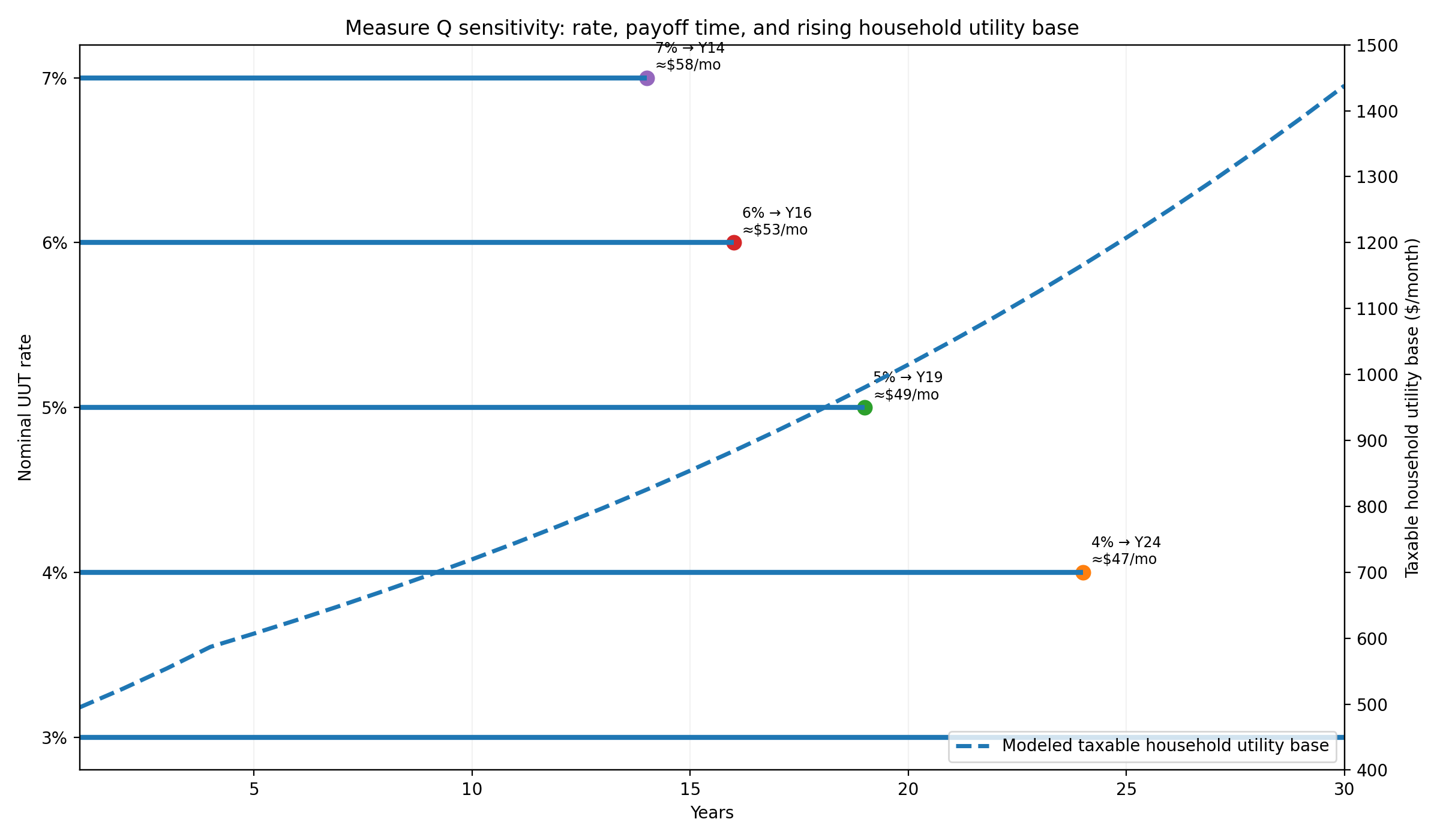
The Debt page therefore includes a separate 3%-7% what-if analysis. Its purpose is to show the relationship among rate, number of accounts, utility-cost growth and payoff time so readers can see the tradeoff rather than being asked to accept one percentage in isolation.
What interest rate does the calculator use?
Late-August 2026 municipal-market data show 30-year AA-category yields around 4.65% to 4.72%. VoteMarinaCA therefore uses 4.75% as a rounded default planning rate. At that rate, $50 million over 30 years has level annual debt service of about $3,160,473.
Try the Measure Q calculator
This calculator lets you change the starting taxable household utility bill and choose a fixed or progressive tax-base model. It then redraws the remaining principal for 3%, 4%, 5%, 6% and 7% UUT rates on the same $50 million loan assumption.
Compare tax rates
| UUT rate | Reduced rate | Full-rate household / month | Full-rate household / year | Year 1 modeled City UUT | Modeled payoff |
|---|
Numbers used in this calculator
| Selected starting taxable household utility bill | $496/month |
|---|---|
| Selected UUT rate | 7.00% |
| Reduced UUT rate used in model | 3.50% |
| Bond principal modeled | $50,000,000 |
| Municipal bond interest rate assumption | 4.75% |
| 30-year level annual debt service | Calculating |
| Starting occupied households | 8,254 |
| Residential mix used | 62% full-rate / 38% reduced-rate group, based on the June 2026 KMA modeling scenario |
| Starting annual commercial taxable utility base | $13,894,000 at a $496 household starting base; scaled proportionally when the household input changes |
| Static model | All baseline tax-base inputs remain fixed for the entire model. The taxable household utility bill does not increase. Residential household count stays at 8,254. The commercial taxable utility base also stays at its selected Year 1 level. Only the bond balance changes over time. |
| Progressive model | Housing grows only through the site's project-linked buildout schedule and then stops. Taxable utility costs grow using the site's stated category assumptions. |
| Debt-payment assumption | All modeled UUT money raised is applied to interest and principal. Measure Q does not legally require this. Actual debt documents and Council decisions would control. |
Check the bond math yourself
The calculation can also be read from the bond backward. At the default 4.75%, the $50 million, 30-year level payment is about $3,160,473/year. The figures below update with the interest-rate control.
| Check | Value | Meaning |
|---|---|---|
| Annual level debt service | Calculating | Principal and interest at selected rate. |
| Annual debt service ÷ 8,254 KMA households | Calculating | Equal-share arithmetic only, not the UUT share. |
| Annual debt service ÷ 896 historical in-city businesses | Calculating | Historical denominator check only. It is not a verified 2026 commercial utility-account count. |
How the calculator works
The calculator is a transparent what-if model. It starts with public City and Keyser Marston data, then applies a small number of stated assumptions so a voter can see how changing the taxable utility bill or the growth model changes the debt curve.
| Input or assumption | Value used | Source / reason |
|---|---|---|
| Starting occupied households | 8,254 | June 2026 Keyser Marston residential UUT model. |
| Reference household taxable utility base | $496/month | KMA all-household modeled average across electricity, gas, water, phone/mobile and video. Users can change this from $200 to $1,000. |
| Residential rate groups | 62% full rate / 38% half rate | KMA draft modeling mix. Final Measure Q who qualifies is defined separately by the ballot language, so this remains a modeling assumption rather than an enrollment forecast. |
| Commercial taxable utility base | $13.894M/year at the $496 reference point | KMA commercial model. When a user changes the household starting value, the calculator scales the commercial starting base proportionally. This is a what-if assumption, not a City forecast. |
| Bond principal | $50M | Current funding scenario used throughout the site. |
| Bond interest rate | 4.75% default; user adjustable | Rounded late-August 2026 AA-market proxy. Not a City bond quote. |
| Static model | No growth | Household utility bill, household count and commercial base stay at Year 1 values. Only loan payments change. |
| Progressive model | Housing buildout + utility escalation | Household count follows the site's project-linked buildout schedule and then stops. Utility costs use the stated category growth assumptions. |
| Use of UUT money raised | All modeled UUT applied to debt | Needed to compare payoff curves. Measure Q is a general tax and does not legally require this share. |
Show the calculation in plain language
1. Household UUT: taxable monthly utility bill × UUT rate. The modeled reduced group pays half the selected rate.
2. Residential City money raised: full-rate households × full-rate monthly tax × 12, plus reduced-rate households × reduced monthly tax × 12.
3. Commercial City money raised: modeled annual commercial taxable utility base × selected UUT rate.
4. Annual debt calculation: beginning principal × 4.75% produces annual interest. Modeled UUT money raised first covers interest; the remainder reduces principal.
5. Repeat by year: the static model repeats the same tax base. The progressive model updates the utility base and household count before calculating that year's money raised.
Why the calculator has more granular controls than the five comparison curves
The five visible comparison curves remain 3%, 4%, 5%, 6% and 7% because they are easy to compare. The highlighted rate control now moves in 0.10 percentage-point increments, so a voter can test values such as 4.3%, 5.2% or 6.4%. The taxable utility input accepts any whole-dollar value from $200 to $1,000, while the slider moves in $5 increments for easier use.
This gives useful precision without adding controls for every assumption. Household count, the reduced-rate modeling mix, commercial base and bond terms remain visible in the assumptions table so the model can be challenged without turning the page into a professional finance application.
What does 3%, 4%, 5%, 6% or 7% actually mean?
The percentage alone is not enough. What a household pays depends on its taxable utility bill. What the City collects depends on the number and type of residential and commercial accounts. This section therefore uses monthly and annual values and does not convert the tax into a daily charge.
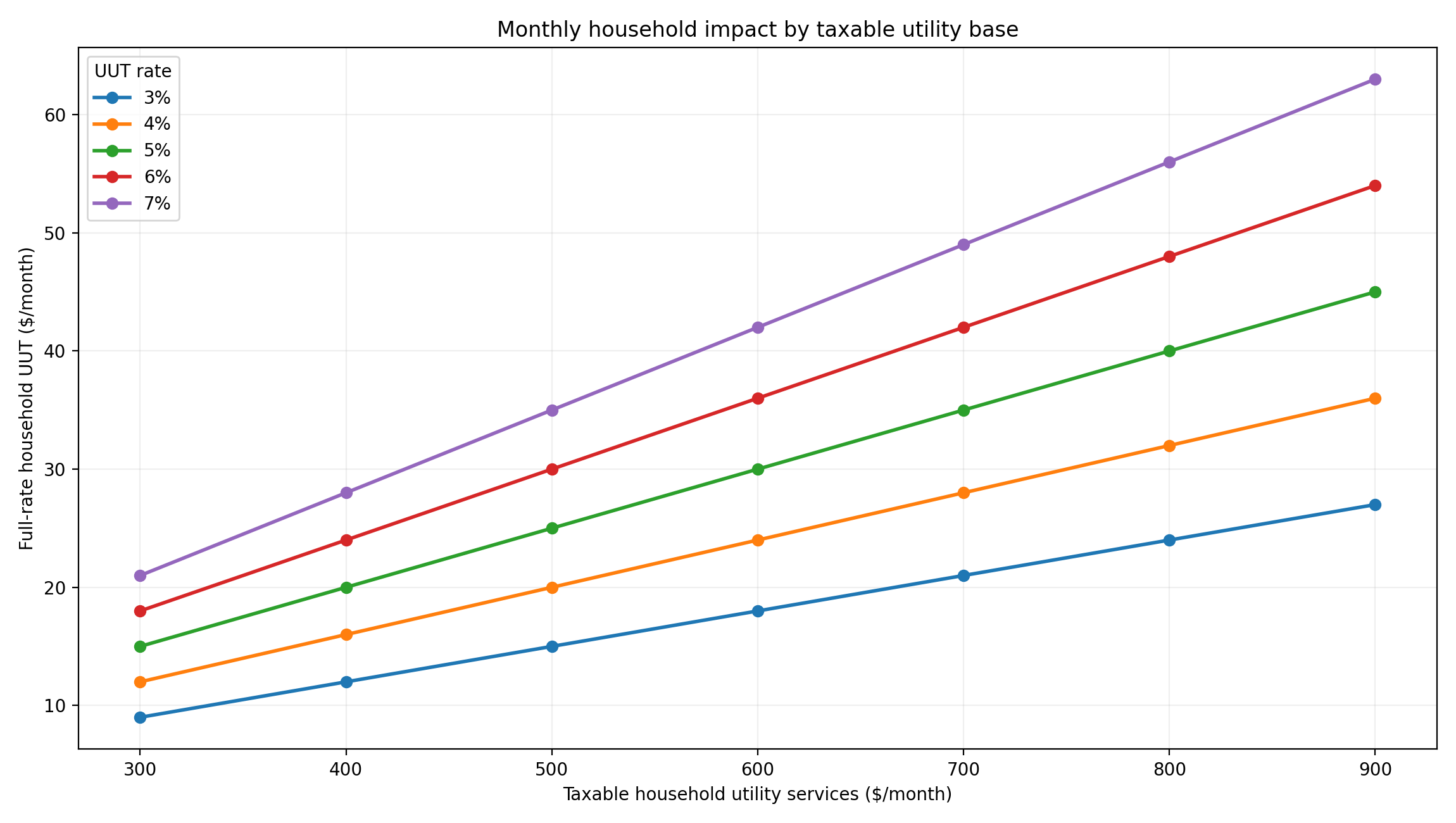
| Taxable utilities / month | 3% | 4% | 5% | 6% | 7% |
|---|---|---|---|---|---|
| $300 | $9.00/mo | $12.00/mo | $15.00/mo | $18.00/mo | $21.00/mo |
| $400 | $12.00/mo | $16.00/mo | $20.00/mo | $24.00/mo | $28.00/mo |
| $500 | $15.00/mo | $20.00/mo | $25.00/mo | $30.00/mo | $35.00/mo |
| $600 | $18.00/mo | $24.00/mo | $30.00/mo | $36.00/mo | $42.00/mo |
| $700 | $21.00/mo | $28.00/mo | $35.00/mo | $42.00/mo | $49.00/mo |
| $800 | $24.00/mo | $32.00/mo | $40.00/mo | $48.00/mo | $56.00/mo |
| $900 | $27.00/mo | $36.00/mo | $45.00/mo | $54.00/mo | $63.00/mo |
How the City's ≈$3.83M annual estimate is built
The City's estimate is not simply one household number multiplied by the number of homes. KMA's June 2026 model combines utility categories, residential groups and commercial utility use. Table 2C uses 8,254 occupied households, an all-household taxable utility estimate of about $496/month, and a modeled 62% full-rate / 38% reduced group. At 7% with the lower group modeled at 3.5%, residential UUT is about $2.84M/year. Table 4 estimates about $970,000/year from commercial utility use at 7%. Together that is about $3.81M/year, close to the City's current rounded estimate of $3.83M/year.
Conservative fixed-base case
This freezes the 2025 KMA household count, the $496/month household utility base and the $13.894M annual commercial utility base. There is no housing growth and no utility-price growth.
| UUT rate | Full-rate household / month | Reduced-rate household / month | Residential UUT / year | Commercial UUT / year | Total UUT / year |
|---|---|---|---|---|---|
| 3% | $14.88 | $7.44 | $1,193,806 | $416,820 | $1,610,626 |
| 4% | $19.84 | $9.92 | $1,591,741 | $555,760 | $2,147,501 |
| 5% | $24.80 | $12.40 | $1,989,676 | $694,700 | $2,684,376 |
| 6% | $29.76 | $14.88 | $2,387,611 | $833,640 | $3,221,251 |
| 7% | $34.72 | $17.36 | $2,785,547 | $972,580 | $3,758,127 |
Growing-cost example
This case lets the documented/project-linked housing base grow to buildout and applies the site's utility escalation assumptions by category. Housing stops growing after the modeled developments are built out.
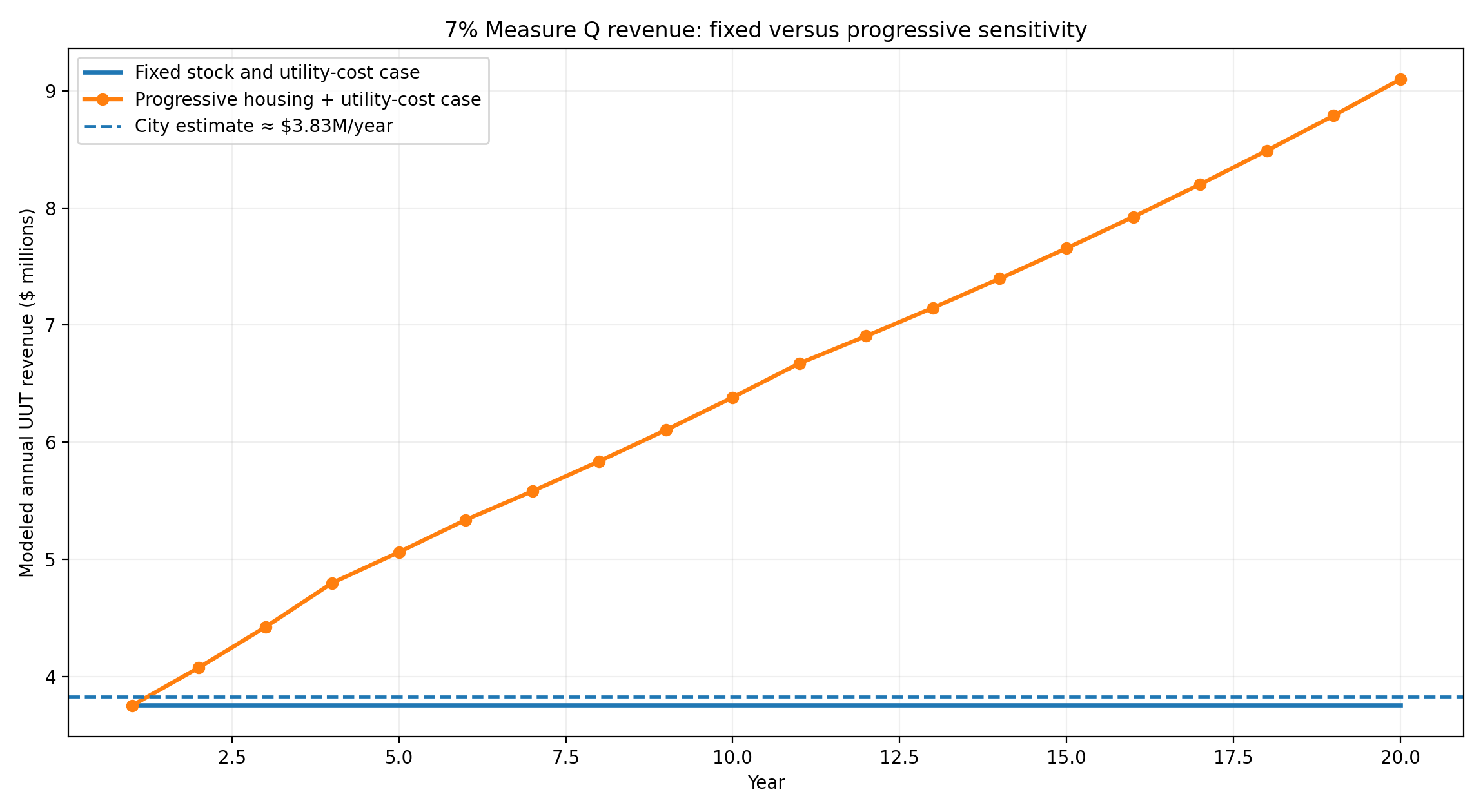
| Year | Residential units | Taxable utility base / household / month | 7% household / month | 3.5% household / month | Total modeled UUT / year |
|---|---|---|---|---|---|
| 1 | 8,254 | $495.00 | $34.65 | $17.33 | $3,752,511 |
| 2 | 8,554 | $523.54 | $36.65 | $18.32 | $4,075,771 |
| 3 | 8,844 | $554.10 | $38.79 | $19.39 | $4,422,951 |
| 4 | 9,133 | $586.81 | $41.08 | $20.54 | $4,799,464 |
| 5 | 9,369 | $607.04 | $42.49 | $21.25 | $5,062,361 |
| 6 | 9,605 | $627.99 | $43.96 | $21.98 | $5,337,941 |
| 7 | 9,741 | $649.70 | $45.48 | $22.74 | $5,582,583 |
| 8 | 9,877 | $672.19 | $47.05 | $23.53 | $5,838,043 |
| 9 | 10,013 | $695.49 | $48.68 | $24.34 | $6,104,795 |
| 10 | 10,149 | $719.64 | $50.37 | $25.19 | $6,383,334 |
| 11 | 10,285 | $744.66 | $52.13 | $26.06 | $6,674,175 |
| 12 | 10,285 | $770.59 | $53.94 | $26.97 | $6,906,550 |
| 13 | 10,285 | $797.45 | $55.82 | $27.91 | $7,147,356 |
| 14 | 10,285 | $825.30 | $57.77 | $28.89 | $7,396,908 |
| 15 | 10,285 | $854.15 | $59.79 | $29.90 | $7,655,534 |
| 16 | 10,285 | $884.06 | $61.88 | $30.94 | $7,923,573 |
| 17 | 10,285 | $915.05 | $64.05 | $32.03 | $8,201,379 |
| 18 | 10,285 | $947.18 | $66.30 | $33.15 | $8,489,319 |
| 19 | 10,285 | $980.48 | $68.63 | $34.32 | $8,787,774 |
| 20 | 10,285 | $1,015.00 | $71.05 | $35.52 | $9,097,138 |
Why Chapter 3.07 looks different from an older utility tax law
Marina's proposed Chapter 3.07 is not written as a one-line tax on “utility consumption.” It defines each covered service, where the service is sourced, which related charges can be included, how bundled bills are handled, how suppliers collect the tax, and how the Tax Administrator can rule on individual billing components.
| Older-style shorthand | Modernized Chapter 3.07 approach | Why it matters |
|---|---|---|
| Tax the monthly telephone, gas or electric charge. | Defines telecommunications, video, electric, gas and water separately and describes related taxable charges. | The taxable base may not equal the consumption line on the bill. |
| Telephone means traditional phone service. | Defines mobile, prepaid/postpaid, VoIP and ancillary communications, with sourcing rules. | Modern communications no longer fit a landline-only law. |
| Cable is one monthly charge. | Defines video programming and many related equipment, activation and service charges. | A modern video bill can contain multiple taxable components. |
| No detailed bundled-bill rule. | §3.07.110 addresses commingled taxable and nontaxable charges and reasonable share. | A bundled invoice cannot always be estimated by multiplying the entire total by 7%. |
| Consumption is the main proxy. | Electricity, gas and water sections expressly include many delivery, customer, metering and service components. | Two households with similar consumption can still have different taxable charges. |
This drafting style is not unique to Marina. California jurisdictions have modernized utility and communications tax laws as telecommunications, video delivery and utility billing became more complex. Los Angeles described its 2008 change as modernizing and clarifying its telephone tax for current technologies. Sacramento's 2008 law likewise said communications technology and billing had changed dramatically. Glendale uses an older UUT for electricity, gas and water and a later communications-tax law for modern telecommunications and video.
Why this matters when comparing the City's estimate with your bill
KMA's June 2026 estimate is a population model, not a prediction of one resident's invoice. It used Marina-specific PG&E usage, an MCWD estimate for a typical single-family home, and broader estimates for phone/mobile and video. KMA calculated about $523/month for its full-rate household example and about $495 to $496/month across all modeled households.
Your tax can differ because your actual services differ from those averages and because Chapter 3.07 defines taxable charges within each service. The bill-entry tool above lets a resident replace the average with their own estimated taxable categories.
Resolution 2026-100 and proposed Chapter 3.07 ↗ · June 2026 KMA utility model ↗
$300, $496 and your actual utility bill: these are different numbers
The distinction is between a funding scenario and an estimated household utility cost. A $300 fixed assumption can show how a lower, non-growing tax base performs over time, but it is not evidence that the typical Marina household actually spends only $300 each month on the taxable utility categories. KMA built its later estimate from Marina-specific PG&E usage, MCWD information and telephone/video estimates.
| Number | What it means | What it does not mean |
|---|---|---|
| $300/month | A lower fixed planning/scenario value used to illustrate a conservative tax-base case. | It is not the City's June 2026 measured/estimated average household cost for all modeled taxable utilities, and it is not a minimum bill each resident must pay. |
| $496/month | KMA's June 2026 estimated average monthly utility cost subject to its UUT model across all Marina households. | It is not a guaranteed household bill. |
| $523/month | KMA estimate for non-CARE/non-senior households in Table 2B. | It is not the tax itself. At 7%, the modeled UUT is about $36.60/month. |
| $444/month | KMA Table 2B average utility cost for the modeled CARE/senior group. | It does not mean every eligible household has this bill; the modeled reduced UUT is about $15.50/month at 3.5%. |
What happens if actual collections are higher?
The proposed UUT is a general tax. The official ballot language estimates approximately $3.83 million annually and allows the money raised to support the listed public-safety, emergency, facility, street and other general City services. The City's facilities work separately identifies an approximately $50 million funding gap after existing resources.
A household loan is a useful analogy, but only up to a point. A mortgage or car loan has scheduled payments, and a borrower may sometimes pay additional principal. Similarly, Marina could structure and manage municipal debt so that available money raised is used for scheduled debt service and, when the bond documents permit economical prepayment, potentially for earlier principal reduction. But because the UUT is a general tax, money raised above scheduled debt service is not automatically required to pay down the bond. The City Council could appropriate it to other lawful general municipal purposes.
Which numbers are estimates?
The 450 commercial accounts and $2,800/month average commercial utility bill in the supplied model remain explicitly labeled as model assumptions unless a primary City record establishes those exact figures. The June KMA work used Marina-specific commercial information, but the site will not substitute a different number merely because it is convenient. Readers can see the assumption and the source method separately.
General tax does not mean no controls
Measure Q is a general tax. The money raised is not restricted by law to the three facility projects and may be used for the public-safety, facility, street and other general City services identified in the measure. That flexibility is real.
Calling it an unchecked blank check leaves out controls in the measure. The City's published language requires the money to remain local, requires spending disclosures and independent audits, and states that the tax continues until ended by voters. The City also says the Council may reduce or suspend the tax.
How do other City issues fit?
Parks, Preston Park, development incentives, litigation, recreation facilities and transportation projects can be legitimate questions without necessarily being the same financial question as Measure Q. Use the City Issues & Measure Q FAQ to see what is directly related, indirectly related, or financially separate.