
What money does the City already have?
A funding analysis should not treat every dollar in the City's accounts as interchangeable cash. The source, restriction and intended purpose of each resource matter.
| Resource / obligation | Example amount | How it enters the analysis |
|---|---|---|
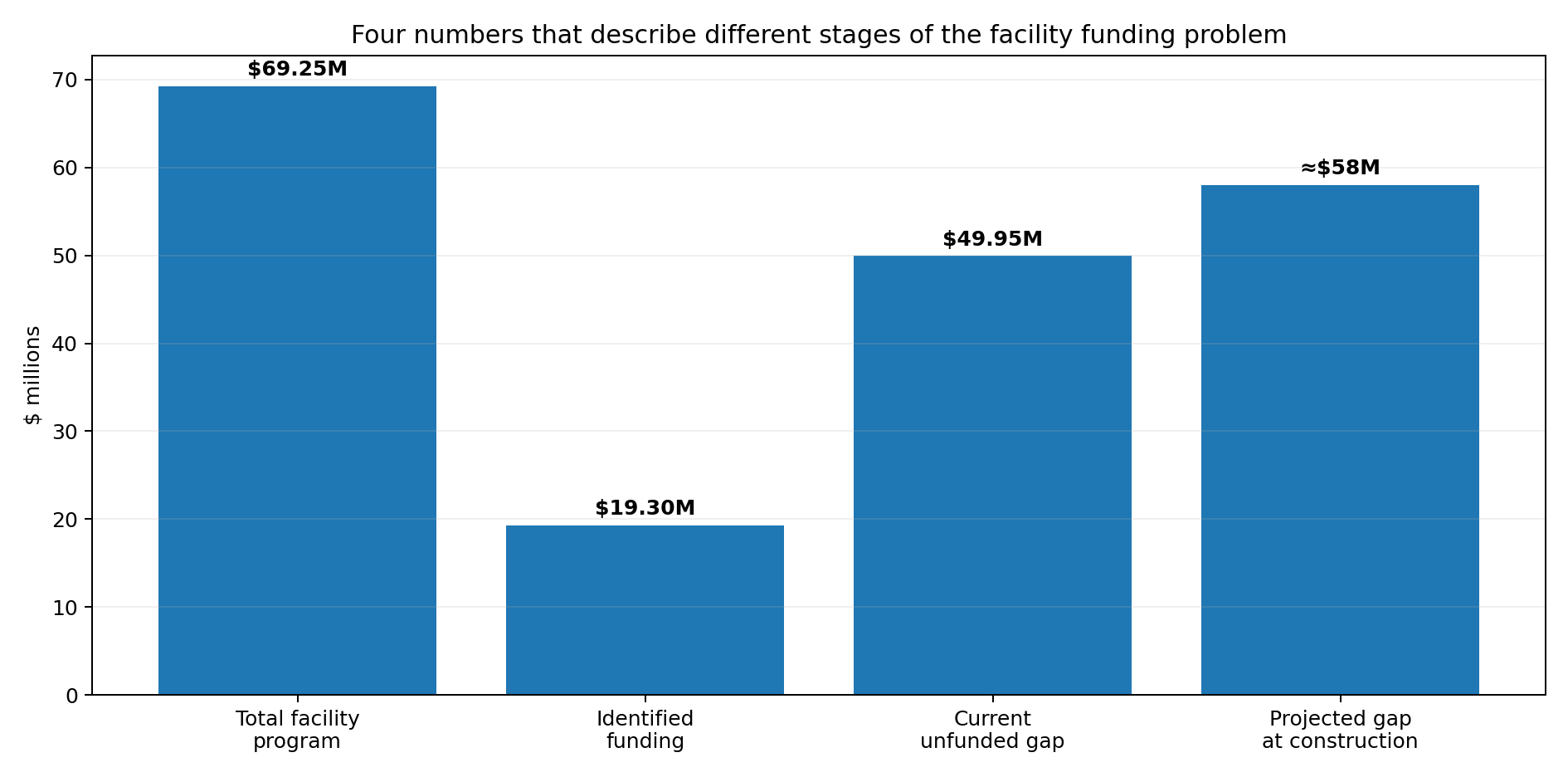
| Existing resources identified for facilities | ≈$19.3M | Reduces new funding requirement. |
| Residual funding | ≈$50M | Approximate amount to finance after existing resources. |
| Other project / maintenance | Varies | Competing needs; should not be double-counted as unrestricted facility cash. |
Pay-as-you-go
Reduces interest costs but exposes projects to construction inflation and delays if annual cash accumulation is insufficient.
Debt funding
Builds sooner and spreads cost across the useful life of facilities, but creates interest expense and a long-term obligation.
What money did the City identify after Measure U?
| Resource | What the public record shows | Can it be treated as unrestricted cash? |
|---|---|---|
| ≈$19.3M identified facility funding | City's 2026 total of grants, impact fees and other sources. | No. Each source must be used consistent with its restrictions. |
| Public Facilities impact-fee category | March 2025 workshop estimated ≈$6.884M ending balance for that category. | No. Development impact fees require a nexus to development-related building and improvement needs. |
| Public Safety impact-fee category | March 2025 workshop estimated ≈$1.784M ending balance. | No. Same nexus/restriction issue. |
| Other impact-fee categories | Roadways, intersections and parks also held balances. | No. Those balances should not be counted toward civic buildings unless legally eligible. |
| General Fund / later facility appropriations | City can appropriate discretionary funds, but those dollars compete with day-to-day and other project priorities. | Potentially, subject to Council budget action and existing commitments. |
The City's ≈$19.3M total is therefore real and relevant, but it should not be described as a single unrestricted savings account. A complete facility funding plan needs to identify which source pays which portion of which project.
March 2025 budget workshop ↗ · Development Impact Fee Study Update ↗ · 2026 Measure Q funding summary ↗
How much was set aside after Measure U failed?
The public record supports a much smaller number than treating the City's entire $19.3M identified funding package as money newly “saved” after the November 2024 bond failure.
| Date / source | Documented facility funding | What is actually identified |
|---|---|---|
| Dec. 2025 CFCAC report | $14.290M identified toward the three priority facilities | About $8.1M Public Facilities impact fees + $4.1M estimated facility reserves for City Hall/Council Chambers + $2.109M Public Safety impact fees for Fire. The $4.1M is the clearest amount expressly described as facility reserves rather than pre-existing/restricted impact fees. |
| Feb. 18 / Mar. 3, 2026 staff analysis | $14.567M designated/restricted through FY2026-27 | $12.419M for City Hall/Council Chambers (facility reserves + Public Facilities impact fees) and $2.148M Public Safety impact fees for Fire. It explicitly excluded $6.5M of unset aside Preston Park funds. |
| March/June 2026 City presentation | ≈$19.3M “partially funded” | The City later describes the package as grants, impact fees and other sources. The public summary does not provide a single line-item breakdown showing exactly how every dollar increased from $14.567M to $19.3M. |
Correction: the $29.8M unassigned General Fund balance is real
The FY2024-25 audited financial report states that Marina ended the year with a $52.4M General Fund balance, including $29.8M classified as unassigned. The ACFR says that unassigned amount is available for spending at the government's discretion. This should not be confused with the much larger $171.4M total across all governmental funds, much of which is restricted or set aside.
FY2024-25 ACFR - see Management's Discussion & Analysis / General Fund balance discussion ↗
Why $171 million does not mean $171 million is free to spend
The FY2024-25 ACFR reports $171.4 million of ending fund balances across all governmental funds. That number is real, but treating it as a single discretionary checking account is incorrect. It combines separate funds with different legal and budgetary purposes.
| FY2024-25 governmental fund | Ending fund balance | Why the distinction matters |
|---|---|---|
| General Fund | $52.42M | Contains the City's broadest discretionary resources, but the balance is not the same thing as an annual surplus or an amount automatically available for one building or improvement project. |
| City Building and Improvement Projects | $45.62M | The ACFR says this balance is earmarked for approved or carried-forward building and improvement projects. |
| Impact Fee Fund | $23.62M | The ACFR says these funds may only be used for improvements corresponding to impacts of new development. |
| FORA Dissolution Fund | $23.23M | Restricted to specified former-Fort-Ord purposes, including blight removal, project improvements and habitat activities within the applicable boundaries. |
| Abrams B debt service + nonmajor governmental funds | About $26.53M | Includes debt-service and numerous special-purpose funds rather than unrestricted General Fund cash. |
| Total governmental fund balances | $171.41M | A total across funds, not $171.41M of unrestricted money available for the facilities plan. |
The more useful ballot question is therefore not “Does the City have $171 million?” It does, in the accounting sense shown above. The useful question is how much of each fund can legally and prudently be moved to the proposed facilities after existing commitments, restrictions, reserves and other project obligations are accounted for?
Preston Park's roughly $13 million is another example
The City did have approximately $13 million set aside in Preston Park, but the 2025 refunding documents identify that money as a planned payment against Preston Park's existing loan. The original $35.95 million interest-only loan matured in February 2026, and the City's refunding analysis assumed applying the $13 million reserve to that debt. Calling the same $13 million simply “available for new City facilities” leaves out the liability it was accumulated to address.
Abrams Park refunding is a funding alternative, not free cash
A proposal to borrow or refinance against Abrams Park can reasonably be discussed as an alternative source of project. It should not be presented as money the City already possesses. Refunding converts an asset or money raised stream into new debt and therefore requires analysis of borrowing capacity, debt service, housing obligations, restrictions, interest cost and risk. The site's funding-alternatives discussion treats it that way.
Some City money can only be used for certain projects
Marina says development impact fees are retained in a separate Public Facility Impact Fee Fund and can be used only for their intended project purposes. They cannot be used for routine maintenance or salaries. The 2025–26 budget material shows a Public Facilities Impact Fee Fund with prior-year balances, ongoing money raiseds and transfers to building and improvement projects.
City impact-fee program ↗ · 2025 Development Impact Fee Nexus Study ↗ · Public Facility Impact Fee Fund budget ↗
| FY 2024–25 estimate | Amount | What it demonstrates |
|---|---|---|
| Beginning public-facilities balance | $6.210M | Restricted project resource |
| Estimated money raised | $0.685M | Continuing development-related inflow |
| Estimated project transfer | $0.010M | Not all balance is automatically available for any facility |
| Estimated ending balance | $6.884M | Balance is restricted by program/nexus |
Why this matters to the $50M calculation
The correct question is not “Does the City have $X million?” It is “How much of that $X million is legally and practically available for the specific facilities being considered?” The 2025 nexus study states that impact fees cannot pay for routine O&M or preexisting deficiencies and must have a reasonable nexus to growth. That is a major reason this site does not subtract every City fund balance from the facility requirement.
City projects compete for money, but not all money is in one pot
The City's CIP covers streets, public facilities, parks and traffic control devices, while separate impact-fee programs fund growth-related project. The General Fund supports ongoing services. These categories should be shown together for opportunity-cost analysis but not mathematically conflated.
City Capital Improvement Program ↗ · City adopted budget ↗General tax does not mean no controls
Measure Q is a general tax. The money raised is not restricted by law to the three facility projects and may be used for the public-safety, facility, street and other general City services identified in the measure. That flexibility is real.
Calling it an unchecked blank check leaves out controls in the measure. The City's published language requires the money to remain local, requires spending disclosures and independent audits, and states that the tax continues until ended by voters. The City also says the Council may reduce or suspend the tax.
Before connecting another City controversy to Measure Q
Marina has legitimate disputes about development agreements, parks, rentals, litigation, public records, old Council decisions and project delivery. A controversy does not automatically become a Measure Q funding fact.
| Test | Question to ask |
|---|---|
| Source | What primary record supports the claim, and what date or decision does it actually describe? |
| Context | Is a later outcome being compared with the facts, prices, contracts or law that existed when the decision was made? |
| Money | Is the amount unrestricted General Fund money that could actually be moved, or is it restricted, set aside, project-specific, future money raised or a negotiated obligation? |
| Magnitude | Even if the claim is correct, is the amount large enough to materially change the facilities funding problem? |
| Measure Q link | Does it change the tax, taxable base, facilities need, funding plan or available unrestricted resources? If not, keep it as a oversight issue rather than using it as a substitute for the Measure Q analysis. |
How do other City issues fit?
Parks, Preston Park, development incentives, litigation, recreation facilities and transportation projects can be legitimate questions without necessarily being the same financial question as Measure Q. Use the City Issues & Measure Q FAQ to see what is directly related, indirectly related, or financially separate.