
How did Marina get from Measure U to Measure Q?
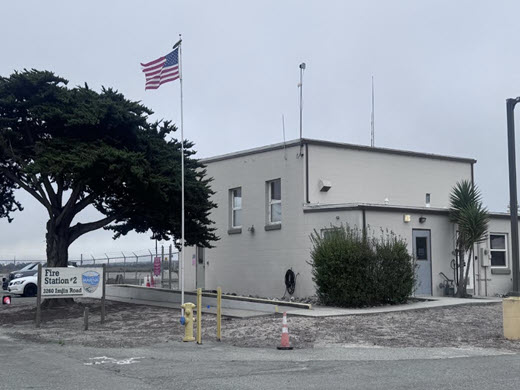
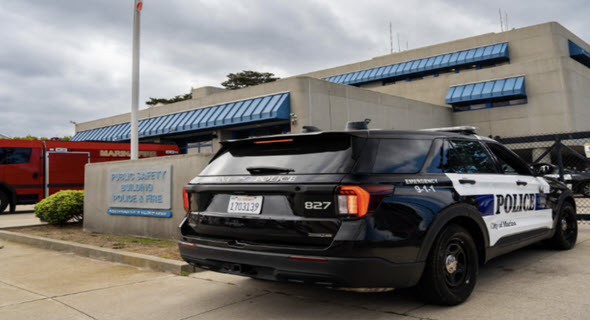
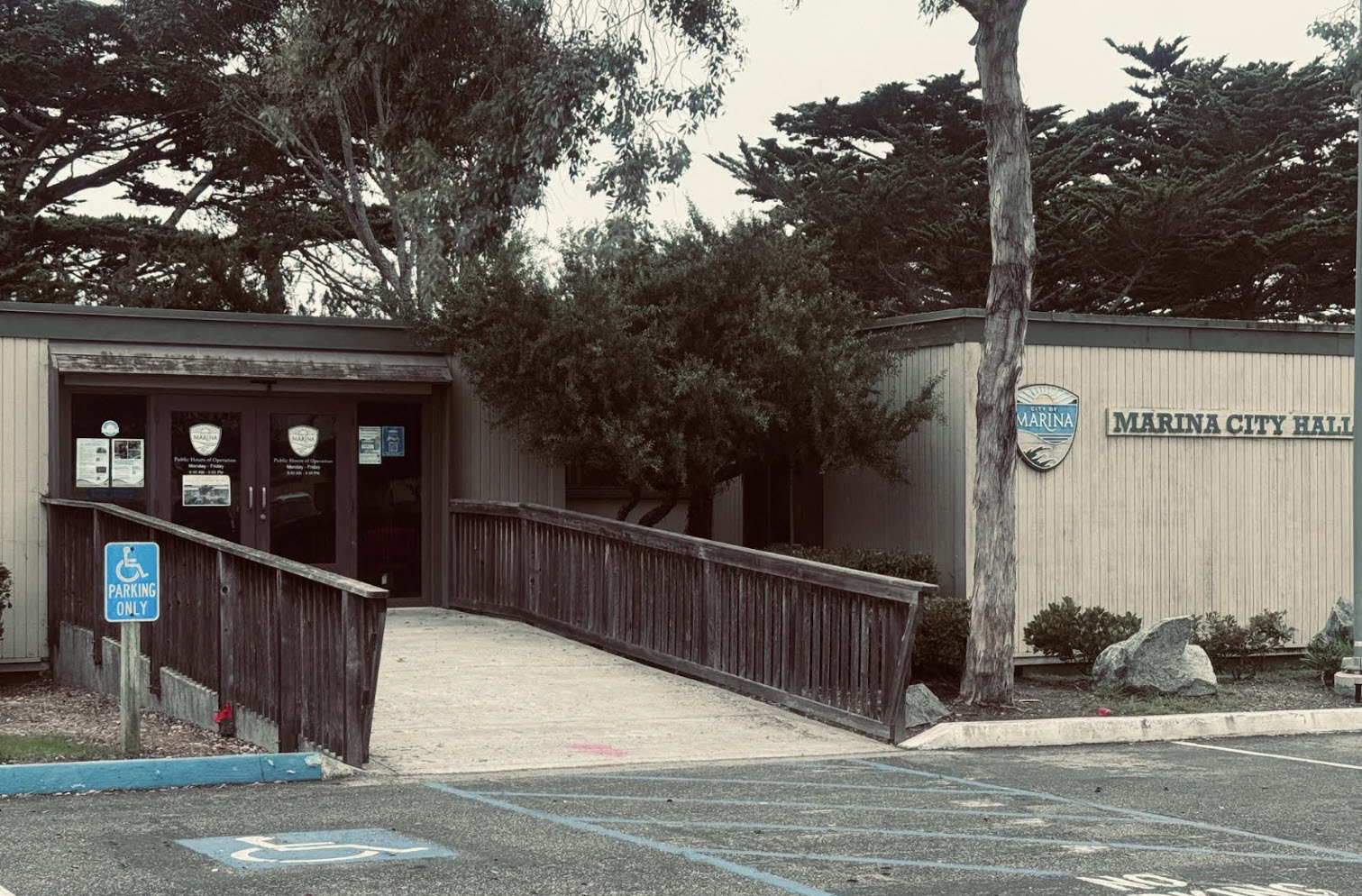
The 2026 UUT did not appear in a vacuum. The funding path changed after the 2024 general-obligation bond failed, while the actual facility problem, existing project resources and development-related money raiseds continued to evolve.
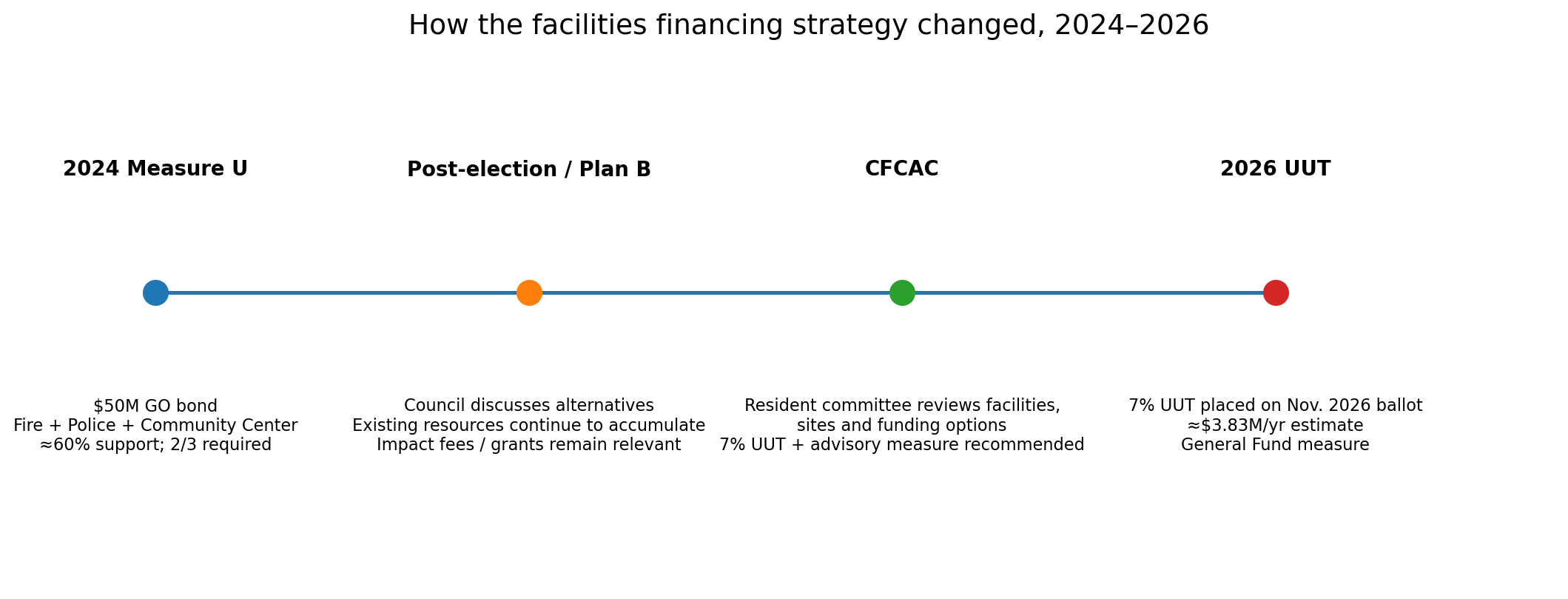
Why the history matters
A voter can support replacement of the facilities while disagreeing about the funding method. The record shows the City moved from a property-tax-backed bond requiring a supermajority to a general UUT that can pass by a simple majority.
1. Earlier bond measure - what exactly did Marina ask voters to approve?
Measure U appeared on the November 5, 2024 ballot. The final measure sought authority to issue up to $50 million of general-obligation bonds. The official City Attorney analysis identified three projects: a new fire station, a new police station and a community center with associated community rooms.
The bond was intentionally restrictive. Bond proceeds could not be used for City employee salaries or general day-to-day expenses. The measure called for an independent oversight committee, annual public reporting, and annual independent financial and performance audits.
The City estimated the property-tax rate required for debt service at $54.74 per $100,000 of assessed value. The measure required two-thirds voter approval unless Proposition 5 lowered the threshold; Proposition 5 did not take effect, so the two-thirds requirement remained.
The City's current facilities page summarizes the election result as 60% support - a majority, but short of the approximately 66.7% threshold. The City interprets that result as evidence that many voters accepted the facility need but not enough accepted that funding mechanism. That interpretation is the City's; the vote itself establishes only that the bond failed to reach the required threshold.
2024 Measure U impartial analysis ↗ · City facilities history and 60% result summary ↗
2. After Measure U failed, did the City start over?
No. The failed bond meant the City did not receive the proposed $50 million in bond proceeds. It did not erase impact-fee balances, grants, General Fund reserves, development-related contributions, or later appropriations for public facilities.
By 2026 the City says it had secured approximately $19.3 million through grants, impact fees and other funding sources toward the three priority facilities.
The March 2025 budget workshop showed an estimated FY2024–25 ending balance of about $6.884M in the Public Facilities impact-fee category alone.
The same workshop showed about $22.172M across all five impact-fee categories - intersections, roadways, parks, public facilities and public safety. Most of that money is restricted to the category/nexus for which it was collected.
The critical accounting point is that not every dollar in an impact-fee fund is interchangeable. Development impact fees are collected to mitigate development-related project impacts and cannot simply be treated as unrestricted General Fund cash. The City's own 2025 nexus-study process emphasizes the required relationship between new development and the facilities funded by those fees.
City 2026 measure page / ≈$19.3M secured ↗ · March 2025 budget workshop / impact-fee balances ↗ · Development Impact Fee Nexus Study page ↗
3. What was the citizens committee asked to do?
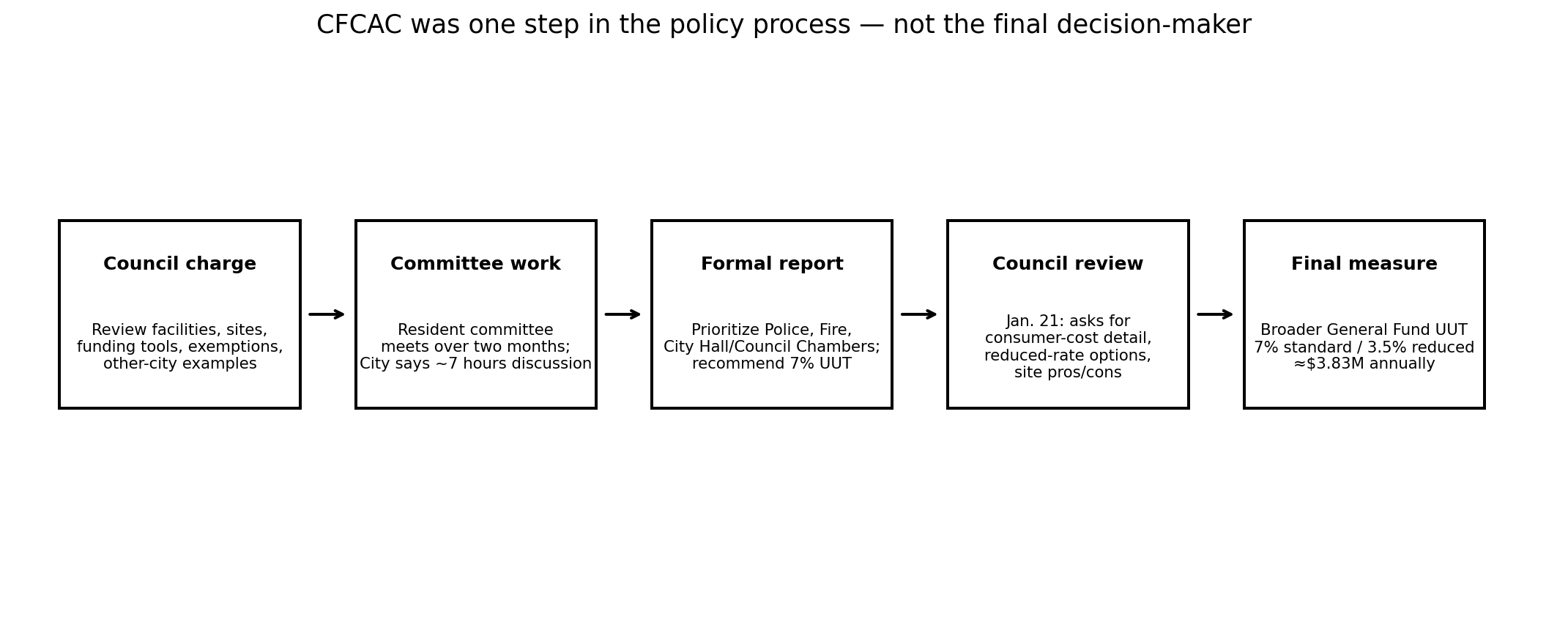
The City Facilities Citizens Citizens Committee (CFCAC) was created in late 2025 after the Council's September facilities study session. The Council's direction was broader than simply “pick a tax.” The record called for resident input on facility conditions and potential sites; continued study of UUT and bond funding; examination of exemptions; comparison with other cities and how they funded facilities; review of voter information from Measure U; and community engagement.
What CFCAC formally recommended
- Prioritize three facilities: Police, Fire, and City Hall/Council Chambers.
- Pursue a 7% UUT under the modeling provided to the committee.
- Consider an advisory vote directing the Council toward facility spending from funds made possible by the UUT.
- Make site recommendations, including a strong recommendation for the Reservation Road area for City Hall/Council Chambers.
The City's current summary says the committee met over roughly two months and held about seven hours of discussion before delivering its report. On Jan. 21, 2026, the Council did not simply adopt every element unchanged. Council asked staff to translate the proposed percentage into actual consumer-dollar impacts, examine income-based discounts/exemptions, and provide additional pros-and-cons information on City Hall site alternatives.
That Jan. 21 record also documents Grace Silva-Santella saying she had not supported Measure U but supported the committee's unanimous recommendation for the Reservation Road City Hall/Council Chambers site. Her later August 2026 Nextdoor statement, supplied to this project, takes issue with how the committee's recommendation was later characterized and argues that a lower 3–4% rate could have been considered once the measure became broader. The later statement is presented as participant testimony, not as a replacement for the committee's formal report.
Sept. 23, 2025 Council study-session record ↗ · Jan. 21, 2026 Council minutes ↗ · City's CFCAC summary and recommendations ↗
4. Why did the City switch to a utility tax?
Measure Q needs a different vote threshold
A general-obligation bond such as Measure U required a supermajority. A general-purpose Utility Users Tax is a general tax and can be approved by a simple majority. That legal difference made a UUT a materially different path after a bond that received majority support nevertheless failed.
Yearly tax money raised can support borrowing
The City's stated goal is not merely to collect $3–4 million each year and wait until enough cash accumulates. The June 2026 analysis modeled how recurring UUT money raised could support a larger amount of borrowing capacity, allowing facilities to be constructed sooner and reducing exposure to years of construction-cost escalation.
Why 7%?
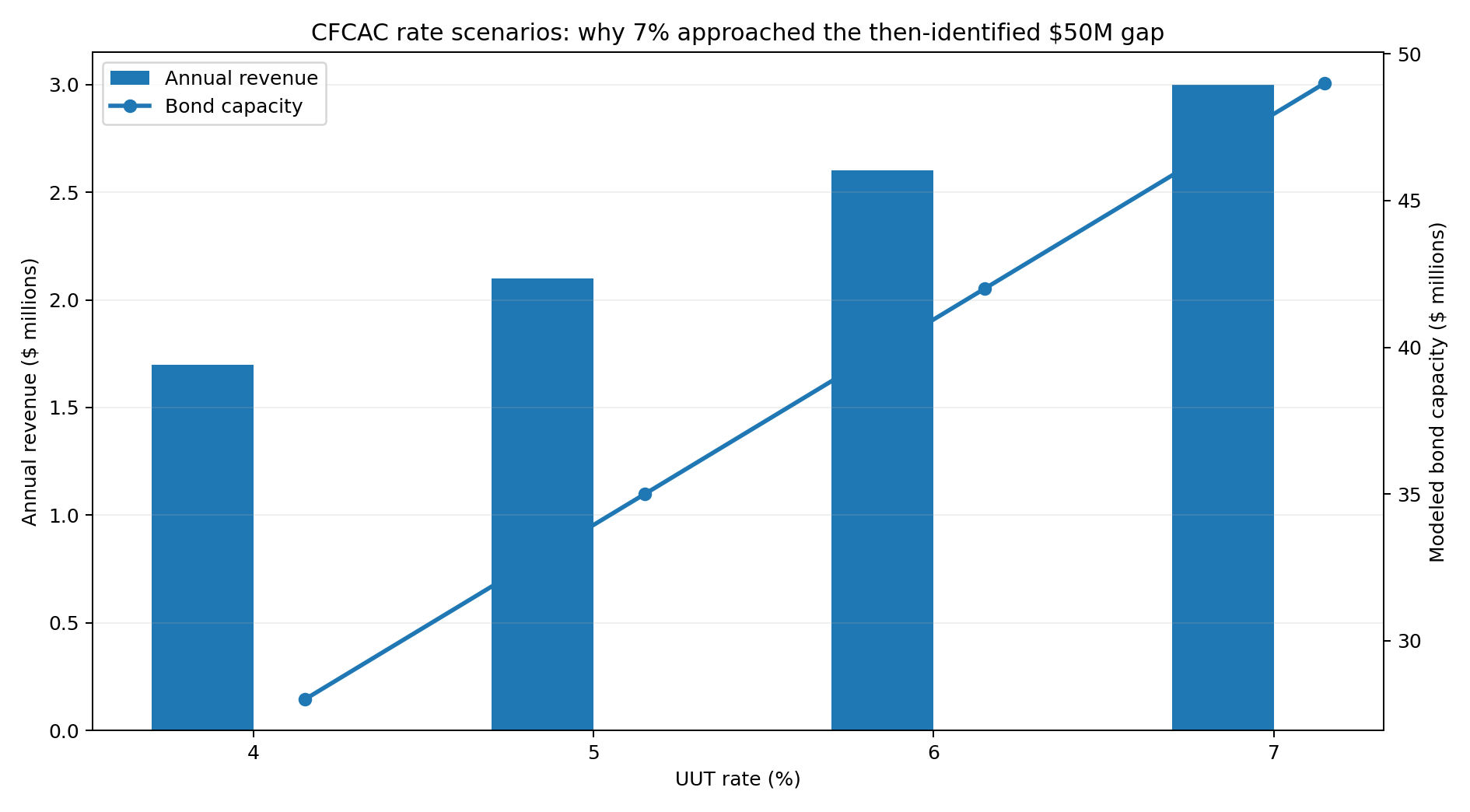
The CFCAC material modeled lower rates as well. In that model, 4%, 5%, 6% and 7% produced progressively larger annual money raised and estimated bonding capacity; the 7% scenario reached roughly $49 million of capacity, close to the then-identified ≈$50 million gap.
By June 2026, Keyser Marston and the City's municipal-advisor work modeled different exemptions. At 7%, estimated annual money raised ranged from about $2.9M to $4.4M, with preliminary bond capacity varying from roughly $44.5M to $66.8M. The final ballot estimate is approximately $3.83M per year.
June 16, 2026 UUT / bond-capacity analysis ↗ · Official 2026 Measure Q page ↗
Who would pay under each plan?
2024 Measure U: based on property value
Measure U's levy was tied to assessed property value, not household utility consumption. That makes the charge larger on property with a higher assessed value, so it is not a flat-dollar household tax. But that does not make it perfectly progressive by income. California's assessed-value system can leave two similar homes with very different taxable values depending on purchase date, and landlords may indirectly incorporate property costs into rents.
The clean conclusion is therefore narrower: Measure U was property-value based rather than consumption based. Its burden did not track household income perfectly and could still be difficult for cash-constrained owners or renters indirectly bearing housing costs.
2026 UUT: based on utility use
A utility tax can be regressive when utility spending consumes a larger share of a lower-income household's budget. Marina's 50% reduced rate for eligible income-eligible residents directly mitigates that problem for those who qualify.
But the reduced rate does not equalize every household. A home with rooftop solar may have a much smaller taxable electricity bill than a comparable non-solar home. Households able to obtain discounted or bundled telecommunications plans can have a smaller taxable base than households buying services separately. Household size, work-from-home needs and service availability can also change taxable consumption.
CFCAC timeline: mandate, four meetings, recommendation, then Council follow-up
The committee was created after the Sept. 23, 2025 Council study session. The mandate was to review current facilities, recommend sites, discuss why Measure U failed, and review funding options that could be placed before voters. All 13 applicants were invited to serve.
| Date | What CFCAC did |
|---|---|
| Nov. 17 | Toured City Hall, Council Chambers, Police/Fire and Community Center; reviewed City finances, facility needs and why Measure U failed. |
| Dec. 1 | Reviewed architectural condition information, peer-city space comparisons and site evaluations. |
| Dec. 15 | Narrowed sites, reviewed estimated facility costs/funding gaps, ballot law, GO bonds, UUTs and a rate table showing 4%-7% options. |
| Dec. 22 | Reviewed the draft report; discussed how much a 7% UUT would actually cost households, what utilities would be taxed, and finalized site/facility priorities. |
| Jan. 21, 2026 | Council received the report and specifically ordered additional work translating the percentage into consumer dollars, evaluating income-based discounts/exemptions and comparing City Hall sites. |
The committee's final scope removed a new recreation/youth/community campus from the immediate $50M facility program. It prioritized only Police, Fire/EOC and City Hall/Council Chambers. It recommended continuing necessary kitchen, bathroom and safety work at the existing Community Center rather than building a new Hillcrest recreation campus at that time.
What changed after CFCAC?
The Jan. 21 Council action is an important dividing line. Council did not simply receive “7%” and move directly to the ballot. The adopted motion explicitly asked staff to ensure the percentage translated into the actual dollars coming out of a consumer's pocket, study income-based discounts/exemptions and return with additional analysis. Later KMA/FM3 work changed the household-cost and exemption picture before the final measure was adopted. [Jan. 21 adopted minutes ↗]
For readers, that means three different records should not be collapsed into one: CFCAC's December recommendation, Council's January request for more analysis, and the final July ballot measure. The website now treats them as separate stages.
Measure U and Measure Q are different
| Feature | 2024 Measure U | 2026 Measure Q / UUT |
|---|---|---|
| Financing mechanism | General-obligation bonds backed by property taxes | 7% Utility Users Tax feeding the General Fund |
| Approval threshold | Two-thirds under the applicable 2024 rule | Simple majority |
| Stated projects / uses | Fire station, police station, community center | Public safety, facilities, streets/potholes and other general City services |
| Amount / money raised | Up to $50M bond authorization | ≈$3.83M estimated annual money raised |
| Duration | Debt until bonds repaid | Tax continues until ended by voters; Council may reduce/suspend under the law framework |
| Accountability | Bond oversight committee + annual financial/performance audits | Spending disclosures, audits and local-spending requirements in the ballot framework |
Before connecting another City controversy to Measure Q
Marina has legitimate disputes about development agreements, parks, rentals, litigation, public records, old Council decisions and project delivery. A controversy does not automatically become a Measure Q funding fact.
| Test | Question to ask |
|---|---|
| Source | What primary record supports the claim, and what date or decision does it actually describe? |
| Context | Is a later outcome being compared with the facts, prices, contracts or law that existed when the decision was made? |
| Money | Is the amount unrestricted General Fund money that could actually be moved, or is it restricted, set aside, project-specific, future money raised or a negotiated obligation? |
| Magnitude | Even if the claim is correct, is the amount large enough to materially change the facilities funding problem? |
| Measure Q link | Does it change the tax, taxable base, facilities need, funding plan or available unrestricted resources? If not, keep it as a oversight issue rather than using it as a substitute for the Measure Q analysis. |
How do other City issues fit?
Parks, Preston Park, development incentives, litigation, recreation facilities and transportation projects can be legitimate questions without necessarily being the same financial question as Measure Q. Use the City Issues & Measure Q FAQ to see what is directly related, indirectly related, or financially separate.