cfac.html solely for compatibility with existing links.
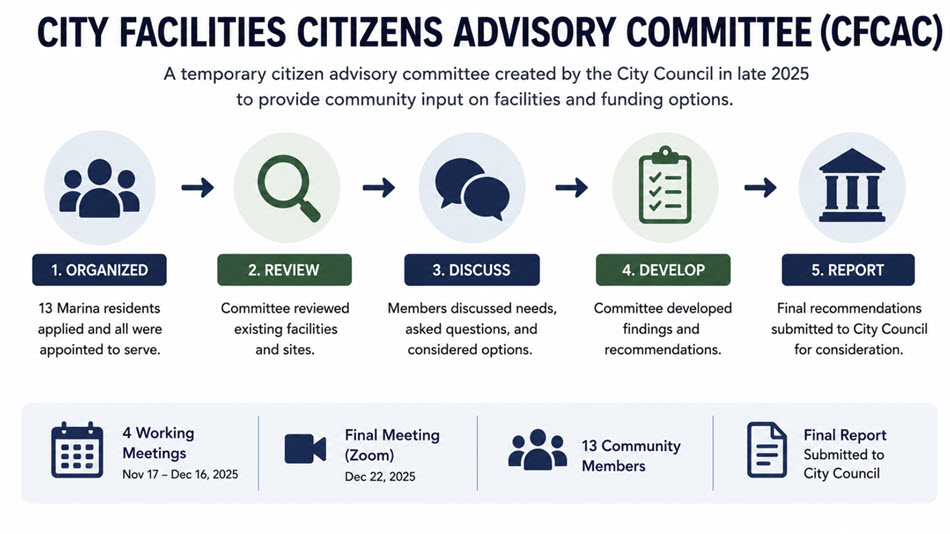
What did the citizens facilities committee recommend?
CFCAC is important because its work is cited as part of the justification for the facilities strategy. The site therefore separates the committee's formal record from later participant recollections.
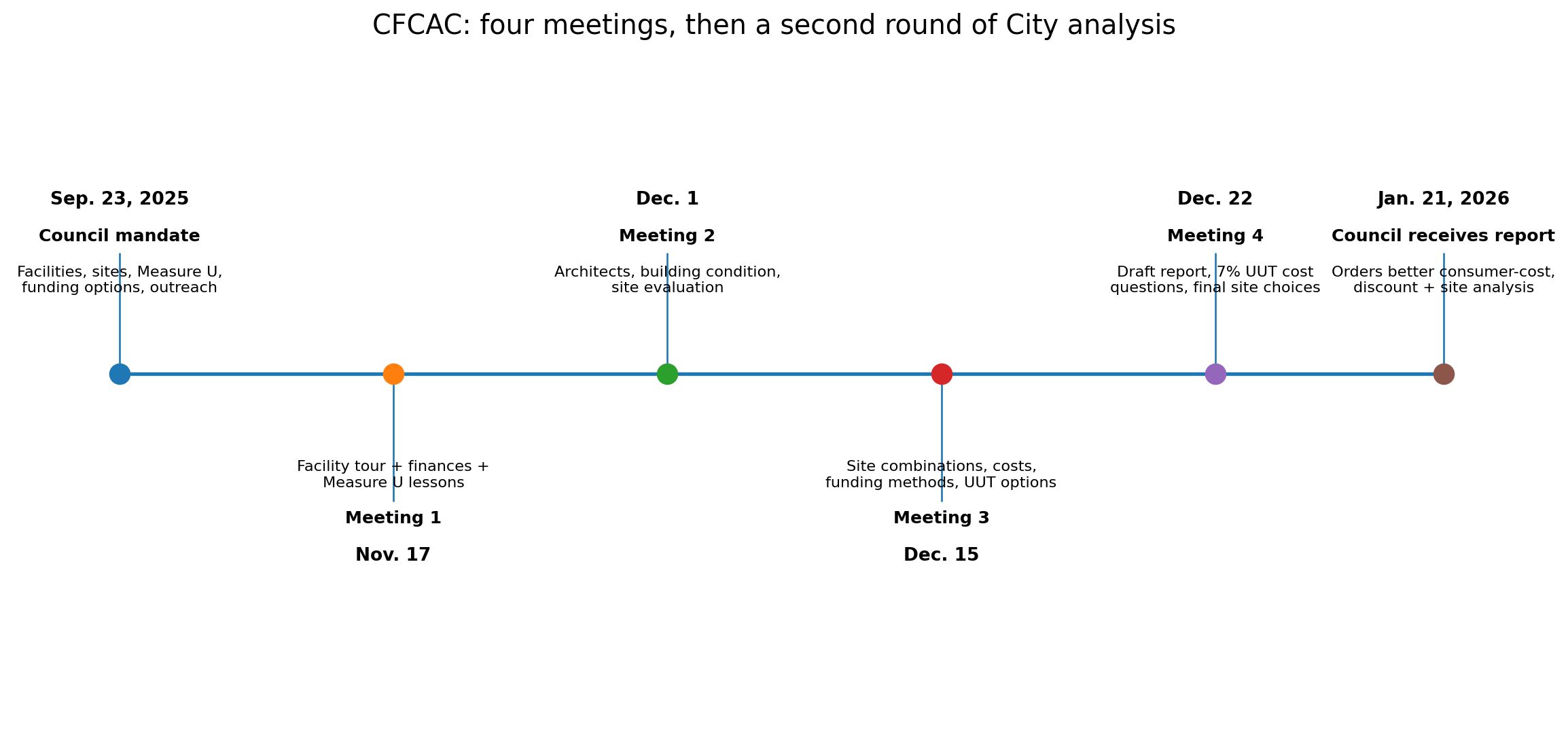
Visual evidence
Images are supplemental. The factual claims on this page are intended to remain traceable to the primary-source links below.
Final CFCAC document vote, according to the record used for this analysis.
UUT rate ultimately proposed by the City; this should not be portrayed as a number CFCAC itself independently selected unless the record establishes that.
Range raised in later participant commentary as a potentially more appropriate rate; distinguish this from the formal adopted recommendation.
What City records show
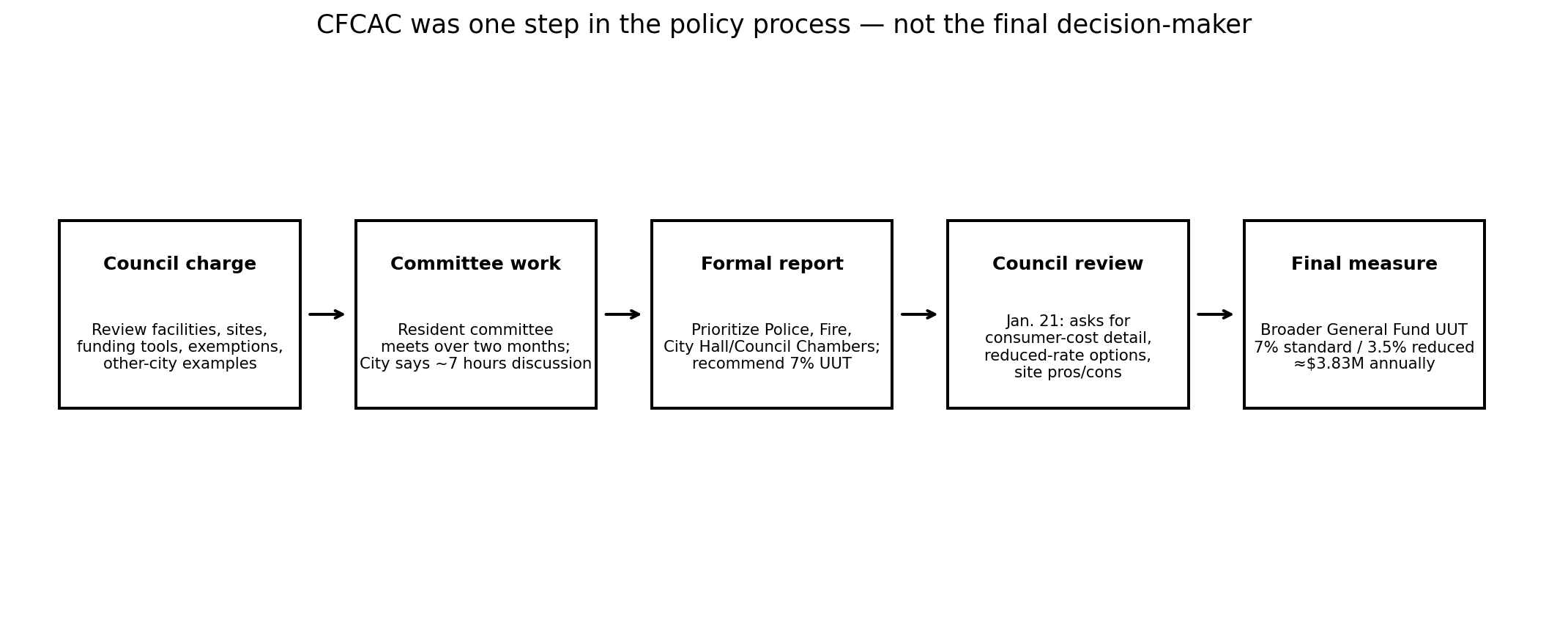
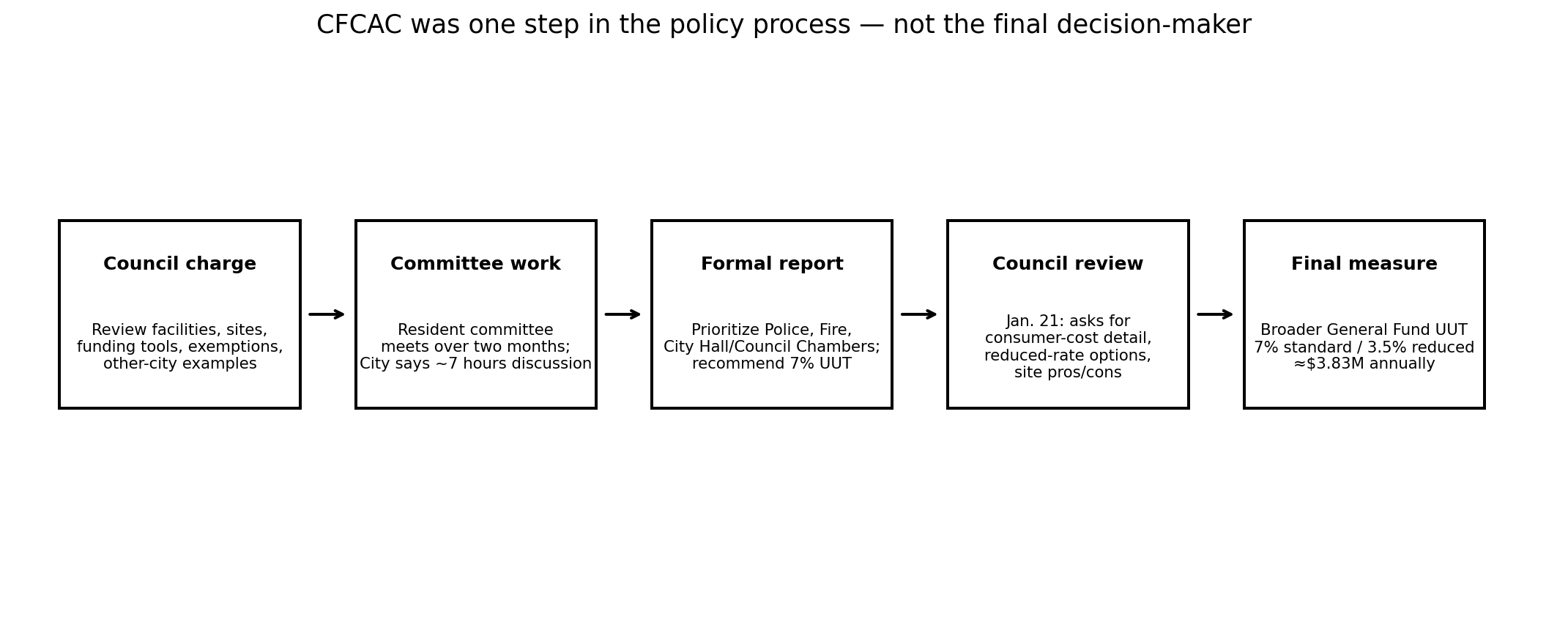
- CFCAC was advisory; the City Council set the assignment and retained final policy authority.
- The committee reviewed facility conditions, sites and funding over roughly two months; the City describes about seven hours of discussion.
- The formal recommendation included a 7% UUT, an advisory spending measure, and prioritization of Police, Fire and City Hall/Council Chambers.
- The Jan. 21 Council action asked for additional consumer-cost, exemption and site analysis rather than treating the report as the final ballot design.
The committee process in plain English
Did CFCAC have choices other than 7%?
Yes. The committee was not presented with only one abstract choice. The record and subsequent Council work show multiple funding approaches and multiple UUT rates were part of the discussion. CFCAC ultimately recommended 7%, and the City's explanation is that the higher rate produced bonding capacity closest to the roughly $50M gap then being discussed.
That explains the arithmetic behind 7%; it does not answer every policy question. A committee can conclude that facilities are needed and still have reservations about scope, sites, exemptions, legal flexibility or how a recommendation will later be used. If members were uncomfortable with parts of the assignment or with how the report was later interpreted, a reasonable retrospective question is whether the committee should also have formally modeled and recommended a lower rate tied to a smaller borrowing target, phased construction, or a mixed-funding strategy.
The May 2026 Council material is also important: after CFCAC, Council explicitly directed staff to examine potential UUT rates from 5% to 7% and options for lower-income discounts. The June staff analysis then reported that polling showed more support for a 7% UUT with low-income relief than for a flat 5% rate. That helps explain the final political choice, while leaving the actual policy tradeoff visible.
January 21, 2026: read the whole CFCAC record, not only the recommendation summary
The January 21 City Council packet is a critical source because it contains both the staff summary and the CFCAC's own report with its supporting exhibits. The staff report summarized the committee's recommendation as a 7% UUT. That summary is accurate, but it leaves out important eligible context contained in the committee report itself.
| What the formal report says | What that means |
|---|---|
| Recommend a 7% general UUT to ensure sufficient funds for the three priority facilities. | This is an unambiguous committee recommendation. The report does not formally condition the recommendation on first trying 3%, 4%, 5% or 6%. |
| The presentation materials showed 4%, 5%, 6% and 7% alternatives, with modeled bond capacity rising from about $28M to $49M. | The committee had lower-rate options in front of it. The arithmetic reason for selecting 7% was that it came closest to the then-discussed nearly $50M funding target. |
| Under the 7% recommendation, the report separately says the City should review the money raised model to clearly explain what residents would actually pay and which utilities would be taxed. | The committee recommended 7% while also acknowledging that consumer-cost communication and the taxable base were not yet sufficiently clear. |
| The report also says modeling and rate setting should be established to generate approximately $3M/year at outset. | This is important context: the actual objective was the money raised needed to support funding, not 7% as an abstract target independent of the tax base. |
| Meeting 4 specifically revisited “just how much the tax needs to be” after members discussed their observed costs under 7%. | The final meeting did not lower the recommendation, but it did identify a need to validate and explain the household impact. |
The extra pages matter
The report's narrative and recommendations occupy roughly the first ten pages, but the attached record continues with the PowerPoint decks from the meetings, agendas, other materials and committee-member emails. Those appendices document concerns about facts versus assumptions, whether presentations steered the committee, trust in how a general-tax money raised stream would be used, and alternative concepts such as building facilities sequentially. Those comments do not undo the unanimous recommendation, but they show that unanimity on the final report did not mean every member was free of reservations about every assumption or later use choice.
January 21, 2026 City Council agenda packet - Item 13(b), Exhibits A and B ↗
January 21, 2026 adopted minutes ↗
What if utility use and the tax base grow?
CFCAC was shown a useful but comparatively simple rate table: lower UUT percentages generated less annual money raised and less preliminary bond capacity, while 7% came closest to the roughly $50M target. The formal report therefore recommended 7%.
What this research did not find in the CFCAC record is a second type of analysis: a multi-year payoff model that simultaneously changed the number of residential accounts, the monthly taxable utility base, and the UUT rate, then calculated how long the same $50M debt could take to retire at 3%, 4%, 5%, 6% and 7%.
That distinction matters because the committee itself asked for clearer household-cost and money raised modeling, and later member comments indicate that the assumed utility bill mattered to how at least some participants viewed 7%. The formal CFCAC report still recommended 7%; later concerns do not rewrite that vote. They do, however, make a what-if calculation useful for understanding what the committee was not shown in the record reviewed here.
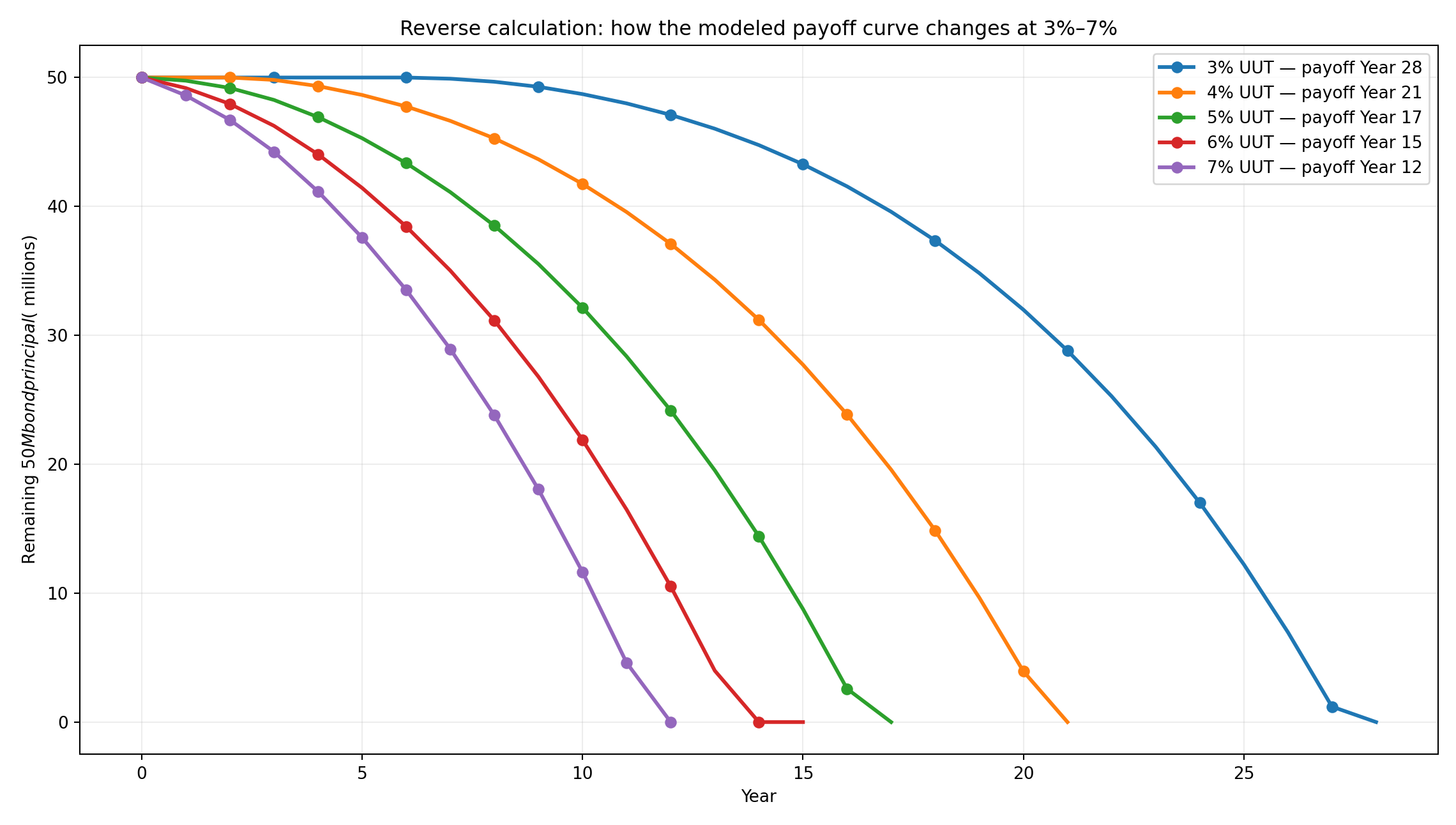
| Nominal UUT | Reduced rate in model | Year-1 full-rate household UUT / month | Year-1 modeled total UUT | Modeled payoff year |
|---|---|---|---|---|
| 3% | 1.5% | $14.88 | $1.72M | Year 28 |
| 4% | 2.0% | $19.84 | $2.30M | Year 21 |
| 5% | 2.5% | $24.80 | $2.87M | Year 17 |
| 6% | 3.0% | $29.76 | $3.44M | Year 15 |
| 7% | 3.5% | $34.72 | $4.02M | Year 12 |
Jan. 21, 2026 packet - complete CFCAC report and appendices ↗ · Jan. 21 adopted minutes ↗
Rate options CFCAC had in front of it
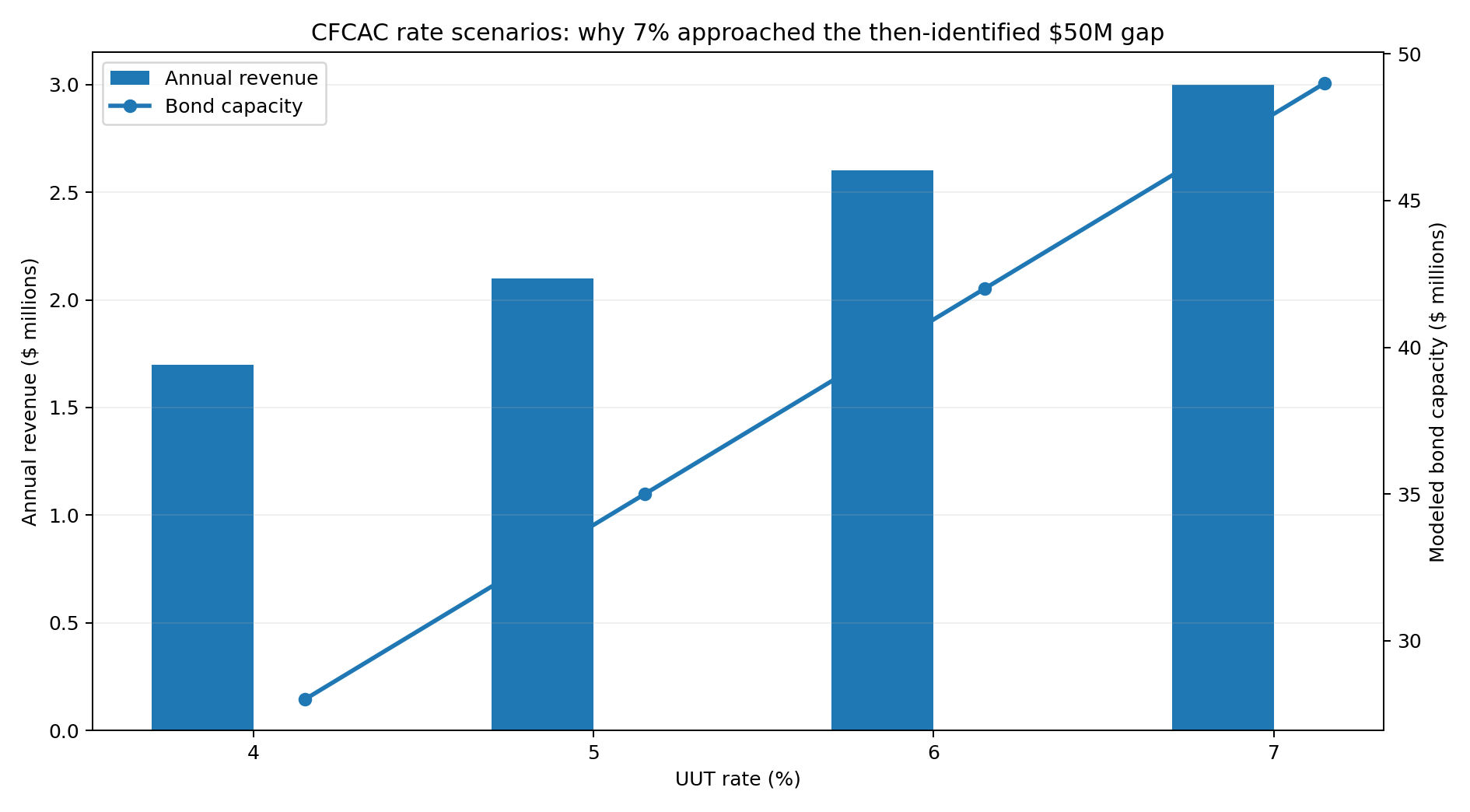
The committee's modeling showed lower rates, not just 7%. The policy tradeoff was straightforward: lower rate, lower annual money raised and lower funding capacity. Under the model presented, 7% was the first listed rate that came close to the roughly $50M funding target.
What the City record says
The City's published report identifies the committee as the What did the citizens facilities committee recommend? (CFCAC). It says the committee recommended a 7% UUT, an advisory spending measure, and prioritizing three facilities: police, fire and City Hall/Council Chambers. It also records that the committee viewed the City's budget as balanced but insufficient to fund all proposed new facilities.
Read the complete CFCAC report ↗ · Read the City’s summary ↗
What the record does not prove
- A later participant statement is not the same thing as a formal committee vote.
- The report does not establish that every member independently selected 7% from an unlimited range.
- The report does not establish that Council was legally bound to follow the committee.
- The report does establish that the committee's formal recommendation included 7%.
The site therefore treats the formal report as the primary record and resident/member recollections as additional context. This is especially important where a participant believes the report was interpreted differently from what the committee intended.
Site-selection question: California Avenue vs. other sites
The CFCAC report contains multiple site options, including California Avenue and Hillcrest/Reservation Road combinations. Separately, a 2022 City analysis concluded that California Avenue/Imjin Parkway could provide four-minute travel-time capability to almost the entire Marina community and said a Marina-Seaside border station would create response gaps. That does not settle the policy question, but it means the site's fire-station discussion must include the response-time study rather than treating location as a simple geographic preference.
Before connecting another City controversy to Measure Q
Marina has legitimate disputes about development agreements, parks, rentals, litigation, public records, old Council decisions and project delivery. A controversy does not automatically become a Measure Q funding fact.
| Test | Question to ask |
|---|---|
| Source | What primary record supports the claim, and what date or decision does it actually describe? |
| Context | Is a later outcome being compared with the facts, prices, contracts or law that existed when the decision was made? |
| Money | Is the amount unrestricted General Fund money that could actually be moved, or is it restricted, set aside, project-specific, future money raised or a negotiated obligation? |
| Magnitude | Even if the claim is correct, is the amount large enough to materially change the facilities funding problem? |
| Measure Q link | Does it change the tax, taxable base, facilities need, funding plan or available unrestricted resources? If not, keep it as a oversight issue rather than using it as a substitute for the Measure Q analysis. |
How do other City issues fit?
Parks, Preston Park, development incentives, litigation, recreation facilities and transportation projects can be legitimate questions without necessarily being the same financial question as Measure Q. Use the City Issues & Measure Q FAQ to see what is directly related, indirectly related, or financially separate.
A critical question: if members disagreed, why did the final report not say so?
The formal record deserves substantial weight. The December 2025 report says it was authored by Ryder Todd Smith and “Reviewed and Content Affirmed” by the CFCAC. The City's summary states that the committee recommended a 7% UUT, an advisory vote, and three priority facilities: Police, Fire and City Hall/Council Chambers.
Later comments from some participants can still be relevant. A committee member may believe the choices presented were too narrow, that the City later interpreted the work differently, or that additional tax-rate analysis should have been performed. But the public report does not document a formal 3% or 4% alternative, a minority report, a conditional 7% recommendation, or a written recommendation rejecting the framework presented to the committee.
This site treats later member statements as evidence of a dispute about process and interpretation, not as proof that the unanimous written recommendation never occurred. Readers should compare the report itself, meeting materials and individual later statements before deciding how much weight to give each.
What information was CFCAC working from?
CFCAC did not begin with a blank sheet of paper. The committee was formed after several years of City facilities planning, including the 2024 work by Roesling Nakamura Terada Architects (RNT). That earlier City-commissioned work identified potential sites, developed high-level conceptual plans, examined existing facility conditions and prepared planning-level cost information.
| Input | What it provided | How to interpret it |
|---|---|---|
| 2024 RNT facilities planning and concept work | Existing-facility assessment, potential sites, conceptual site plans and planning-level facility information. | Pre-existing City planning material. It provided a developed starting point for the later facilities discussion rather than a new design process created by CFCAC. |
| RNT architects participating in CFCAC meetings | Ansgar Killing and Tyson Cline of RNT were identified in the final CFCAC report as experts who joined committee meetings to provide information and answer questions. | This connects the committee directly to the City's earlier professional facilities-planning work. |
| City staff and department leadership | City Manager, Finance Director, Fire Chief and Police Chief provided operational, facilities and financial context. | Important subject-matter input, but principally information supplied by the City whose facilities and funding strategy were being reviewed. |
| City legal counsel | Information concerning available funding and ballot-measure approaches. | Legal and structural guidance rather than an independent public-policy recommendation. |
| Tripepi Smith facilitation | Meeting facilitation, prepared material and preparation of the final committee report. | The final report was consultant-authored, then reviewed and content-affirmed by CFCAC. |
Important limitation: The available CFCAC report establishes that RNT architects participated and that the committee reviewed facilities and potential sites. It does not, by itself, establish that every page or drawing in the April 2024 RNT package was shown at a particular CFCAC meeting. The website therefore treats the RNT package as part of the documented planning background and source material connected to the committee process, not as proof that each individual concept drawing was formally adopted or reviewed page by page.
Later CFCAC member comments: what they add to the record
Jason Smith, August 24, 2026
In an August 24 Nextdoor discussion, former CFCAC member Jason Smith gave a detailed account of his experience. His comments add evidence that at least some members questioned assumptions before the final report was approved, including utility-cost assumptions, the proposed tax rate, available funding, facility choices and the desire for an advisory vote.
Smith described attempting to suggest language supporting a rate below 5% during review of the consultant-prepared report and said those edits were not reflected in the final document. He also described a short review period and a consultant-controlled document. These are later participant statements and do not substitute for the official meeting record or adopted report.
The important qualification
Smith also acknowledges that committee members ultimately agreed that the consultant work product adequately represented their efforts and signed off on it. The later criticism therefore does not change what CFCAC formally recommended.
His account instead adds another layer to the record: some members apparently believed important questions remained unresolved while considering the final product. That makes it reasonable to examine both how the process was managed and how the unanimous recommendation was later presented to the City Council.
What cannot yet be established: whether those concerns represented most of the committee, whether members intended approval to be conditional, or why members who remained dissatisfied did not formally qualify the recommendation, submit a separate statement, request additional deliberation or vote against the final report.
An unresolved question
If several members believed the utility assumptions, rate analysis or other important issues remained unresolved, why did the committee approve a final report that did not formally preserve those objections?
Possible explanations include the short advisory process, reliance on a consultant-prepared document, members viewing the report as a summary rather than a binding policy decision, or a desire to provide Council with a consensus recommendation despite individual reservations. The available record does not establish which explanation is correct.
How much should voters rely on the committee?
CFCAC was not a standing commission and did not approve Measure Q. It was a temporary citizen citizens committee created to provide community input on facilities and funding options. Its recommendation became one input used by the City Council.
Its importance to Measure Q comes largely from the City's later use of the unanimous 7% recommendation as evidence supporting the funding approach. Both parts of the history therefore matter: the committee formally recommended 7%, and later statements indicate that some members believed unresolved questions were not visible in the final recommendation.
A useful distinction for voters: CFCAC advised. The City Council decided.
Source limitation: The August 24 comments are a later participant account posted publicly on Nextdoor. Any contemporaneous email or draft described in that account has not been independently obtained for this site. This section can be updated if additional public records or member statements become available.